Dr. Margaret Ellison: How to End the 2pm Energy Crash After a Year on a GLP-1 - Without Another Cup of Coffee
(From an Obesity Medicine Physician Who Spent Over a Year Trying to Solve Her Own Fatigue)

Before you pour another coffee, read this. If your afternoons have gone flat a year or more into a GLP-1, the cause is not your sleep and it is not your willpower. It is a micronutrient shortfall I call the "Smaller Plate Gap". Here is exactly how to close it.
My name is Dr. Margaret Ellison.
I am a physician, board-certified in obesity medicine, with 19 years in practice. I prescribe GLP-1 medicines every week, and I have taken one myself for more than three years.
Over the past four years I have guided more than 600 patients through GLP-1 treatment.
So I understand long-term fatigue from both sides of the desk.
But I owe you an uncomfortable admission.
Even with 19 years of clinical experience, I had no explanation for what was happening to my own energy on this medication.
I have examined enough exhausted patients to recognize someone who is doing it all correctly and still running on empty. That year, I saw her in my own mirror.
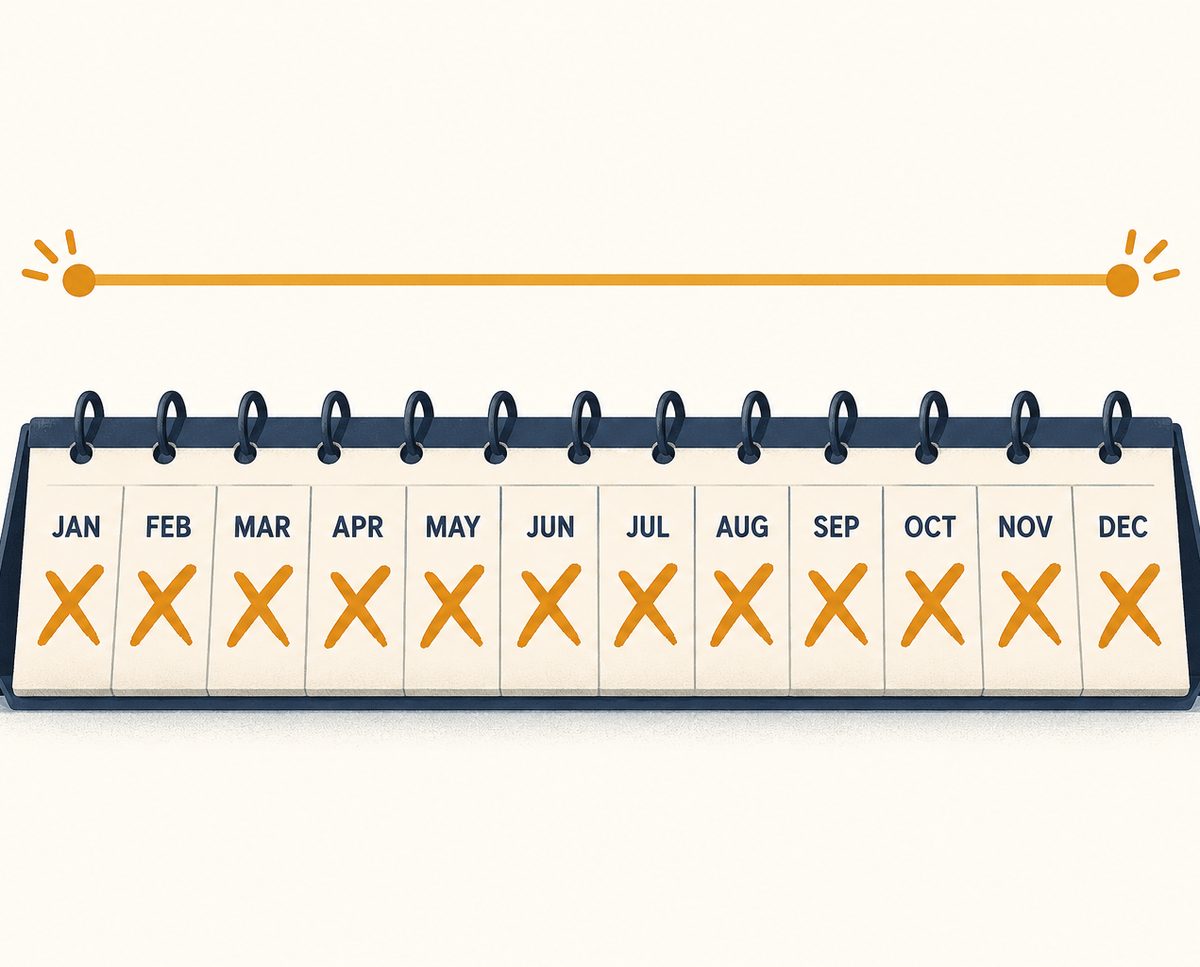
Twelve months crossed off, and a steady, level energy line.
I started on Mounjaro, and later I moved across to Zepbound. On both, my experience followed one identical course.
My first year went exactly as the prescribing literature predicts: the weight came down, and the food noise went quiet.
Then the energy went.
By 2pm, four afternoons out of five, I was fully depleted - not sleepy, just empty, with half the clinic schedule still ahead of me. That continued for over a year.
And the symptoms accumulated.
I slept seven or eight hours and woke as if I had slept four. Some nights I lay awake, wired, and the next afternoon I would read the same laboratory report twice.
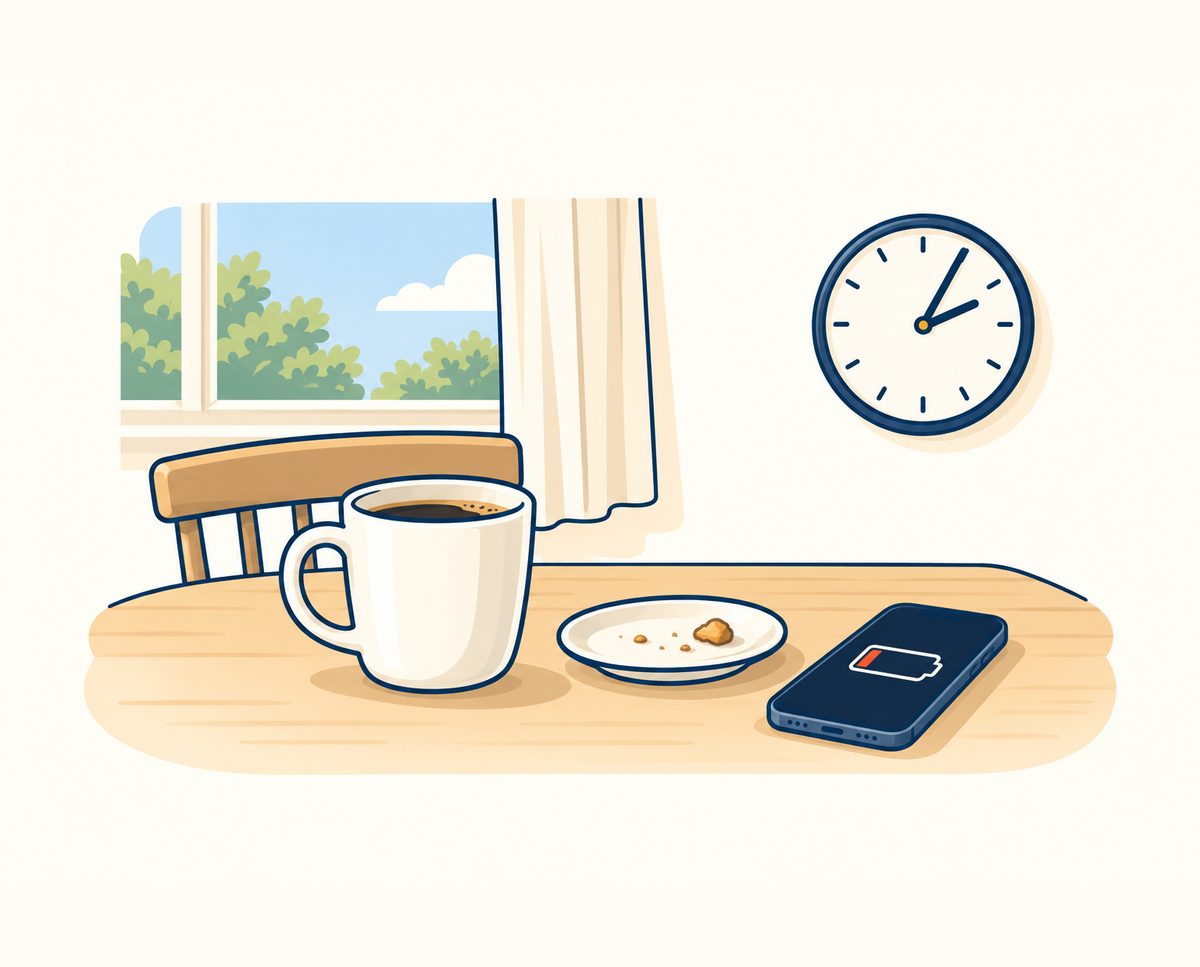
A kitchen table by the window at five past two: a coffee, an empty plate and a phone on low battery.
And it started draining the rest of my life.
I did not want to see patients, and I did not want to open another chart.
At home I gave up my walks and lost interest in cooking, and I ignored a close friend's calls for a whole week. By dinner I had nothing left for my own family.
One afternoon I sat in my office between consultations, surrounded by nineteen years of clinical references, and thought: I manage this treatment for a living. And I am unable to manage my own afternoons.
That was the afternoon I stopped medicating the fatigue with caffeine and started investigating the mechanism behind it.
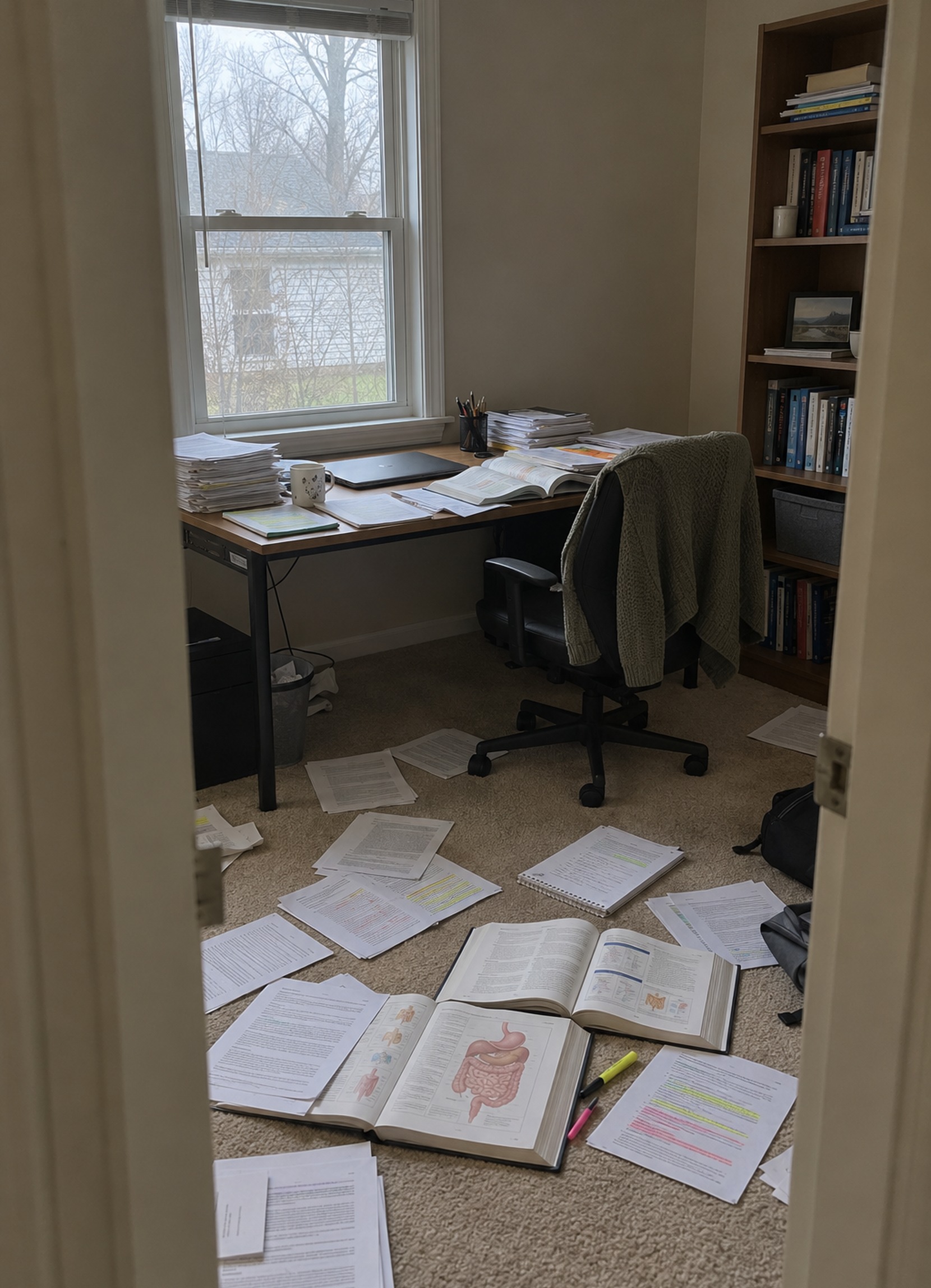
My home office, the week I started digging - Scottsdale, AZ | May 20, 2024
After living through it myself, I started hearing the same complaint from patient after patient - almost never during the first year, always twelve months or more into treatment, and always delivered as an apology: "I think I am just getting lazy."
Today I can usually predict, from a single week of a patient's food diary, who is approaching that 2pm wall.
It has nothing to do with laziness. Nothing to do with getting older. And nothing to do with needing more willpower.
It comes down to one thing: the micronutrients a suppressed appetite quietly removes from your plate, month after month.
Let me ask you something. If you are beyond your first year on a GLP-1, are any of these familiar?
- Functioning normally all morning, then flat by about 2pm, most days.
- Sleeping 7 or 8 hours and waking as if you had slept 4.
- Wired and restless at night, then cognitively foggy the next day.
- A second or third coffee that delivers far less than it used to.
- Nothing left by evening for the things you used to enjoy.
- Eating far less than before the prescription - and none of this was happening during your first year.
- Paying for the prescription month after month, and too exhausted to enjoy what it achieved.
If you recognized two or three of those symptoms, I need you to understand what they mean.
These are not symptoms you grow out of. They are the reason your afternoons disappeared, and they do not resolve while the plate stays small.
In 2025 the journal Obesity Pillars published an analysis of insurance claims for 461,382 adults newly prescribed a GLP-1 medication. More than 1 in 5 received a nutritional deficiency diagnosis within twelve months.
Yet most patients on these medications have never been told that reduced caloric intake and persistent fatigue are connected, so they assume exhaustion is simply the cost of the weight loss.
It is not. It is evidence that the gap is still widening.
Each of those symptoms is a depletion signal, and a depleted body does not produce steady energy, however many hours you sleep.
I will explain precisely how it happens - the mechanism I call the "Smaller Plate Gap" - and how to close it for good.
It is the same approach that restored my own afternoons, and restored them for more than 600 patients I have guided through GLP-1 treatment.
The "Smaller Plate Gap" Mechanism (Where the Fatigue Comes From)
Long-term fatigue on a GLP-1 is not random. It develops when nutritional intake stays below physiological requirement, month after month.
A GLP-1 suppresses appetite and slows gastric emptying, so you eat less. And you continue eating less, for as long as you remain on the prescription.
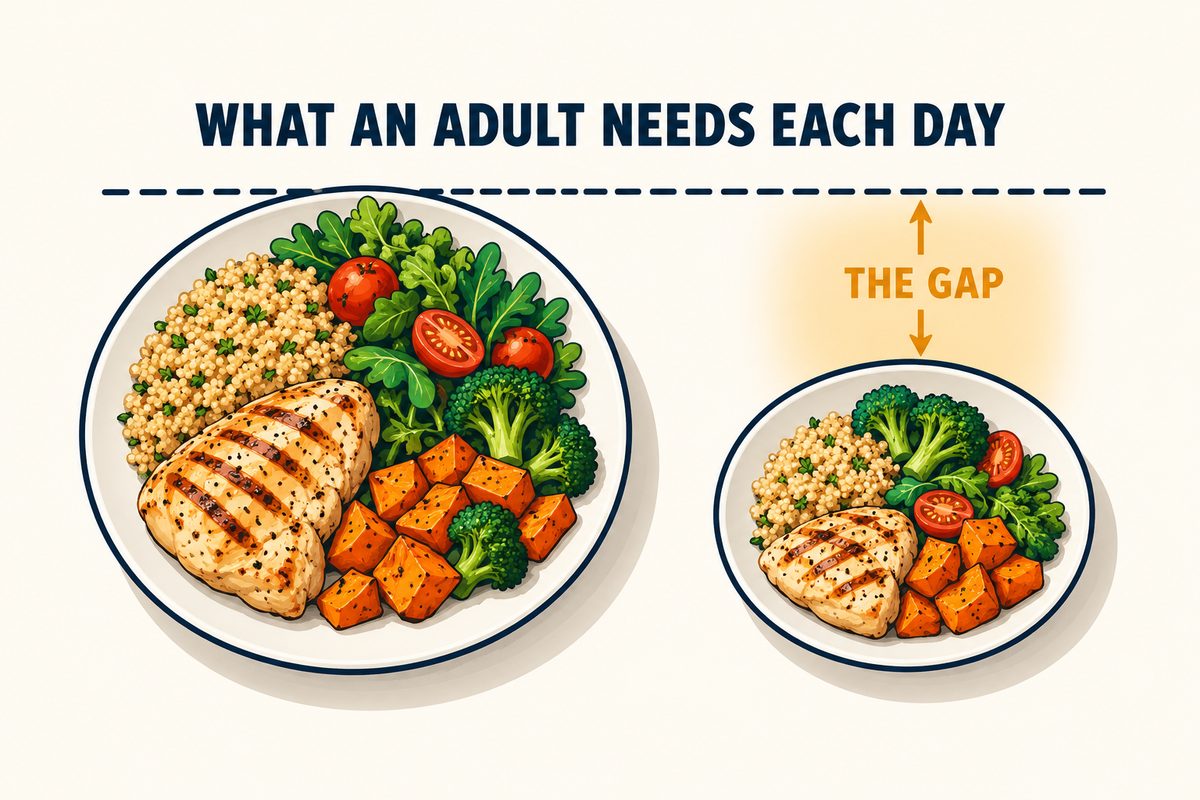
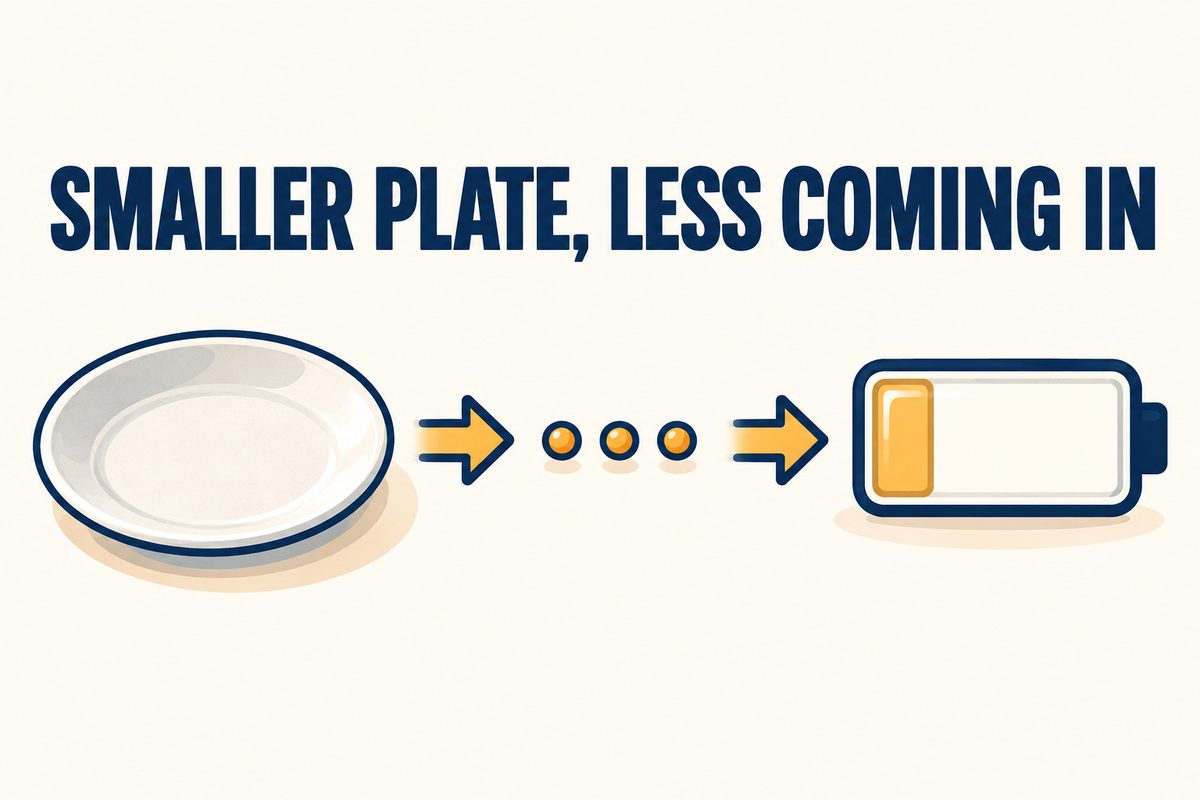
Each micronutrient your metabolism depends on arrives with food, and a smaller plate delivers fewer of them. But an adult's daily requirement is determined by age and sex, not by portion size.
Your body responds: "I am being asked to run a full day on half a delivery. I am conserving energy until the supply comes back."
And here is the paradox of long-term GLP-1 treatment:
The same suppressed appetite that removed the weight is now removing your energy.
How the Gap Drains Your Energy and Sabotages Your Day
The same analysis compared 4,505 patients on a GLP-1 plus metformin against 4,505 similar patients on metformin alone. Within twelve months, 18.6% of the GLP-1 group carried a diagnosed nutritional deficiency - a higher proportion than the comparison group.
Why does that matter? Because each depletion eventually becomes a symptom you can feel.
1. The Afternoon Problem
You might consider the 2pm crash an inconvenience, but your metabolism treats it as a fuel emergency.
Fatigue is a documented effect of these medications. On the prescribing label of one widely used GLP-1, fatigue was reported by 11% of participants on the medication, against 5% on placebo, over 68 weeks.
The bottom line: the fatigue is real, it is documented, and caffeine does nothing about the cause.
2. The Sleep Problem
Do you sleep 7 or 8 hours and wake as if you had slept 4? Do you go to bed earlier and notice no difference at all? Do you need caffeine before you are capable of conversation?
Two out of three of my long-term patients describe exactly this: adequate hours of sleep, and waking exhausted all the same.
The physiology is unambiguous about what follows. Sleep restores you, but it does not nourish you.
The result: when a micronutrient is missing from the plate, no quantity of sleep replaces it.
3. The Wired-and-Foggy Problem
This might be the most disruptive of the three, and the least discussed.
Exhausted all day, then wired at night, with irritability closer to the surface. And after a poor night, does your concentration evaporate mid-sentence the next day?
It was the one that disturbed me most, because my profession depends on a clear head.
Why? Because a body that is short on supply never fully powers down.
The result: a depleted body never fully settles and never fully recovers, so each day begins from a deficit.
Hence the Coffee That Stopped Working

My third cup of the day, 14 months on Mounjaro - Scottsdale, AZ | March 2024
So why do the second and third cup stop working a year or more into treatment?
It is not caffeine tolerance, and it is not your age. The #1 reason is the plate.
Caffeine does not supply energy - it blocks the adenosine signal that tells you that you are fatigued. Then it wears off, and the fatigue is just where you left it.
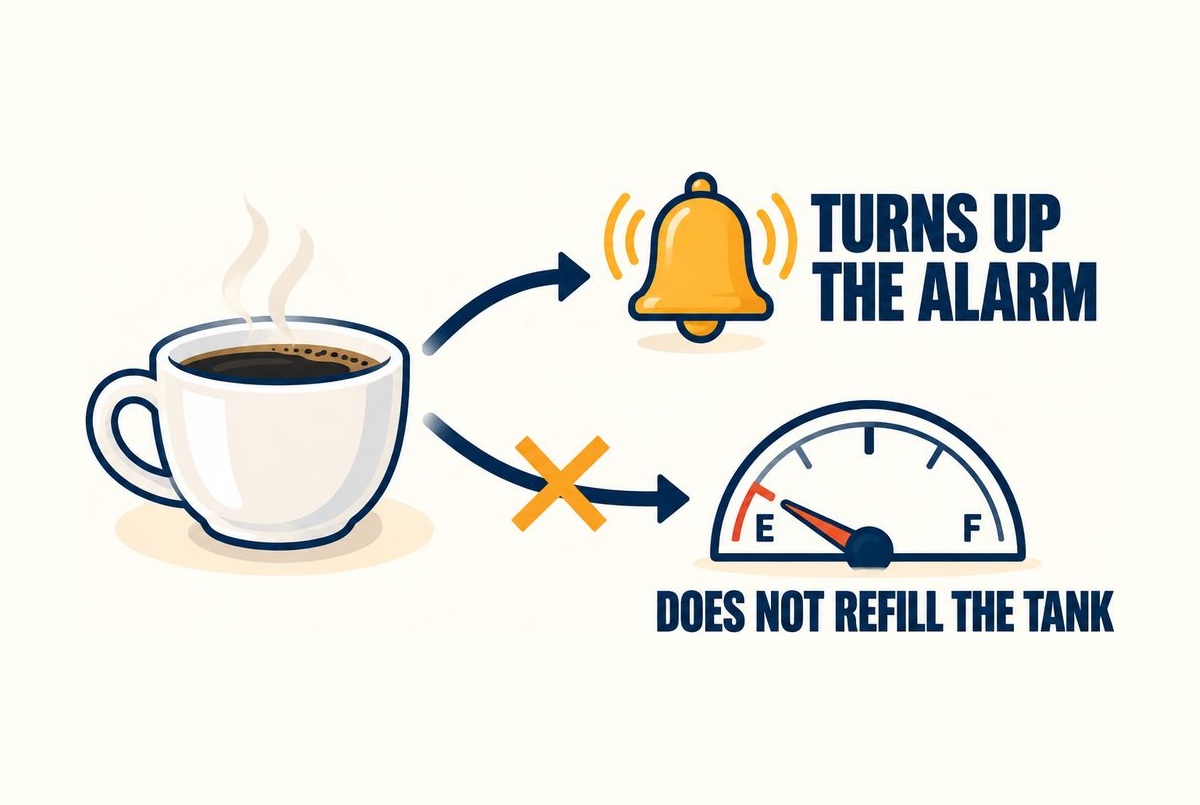
A cup of coffee contributes almost nothing to a smaller plate.
I was drinking my third cup by early afternoon, and each week it accomplished a little less.
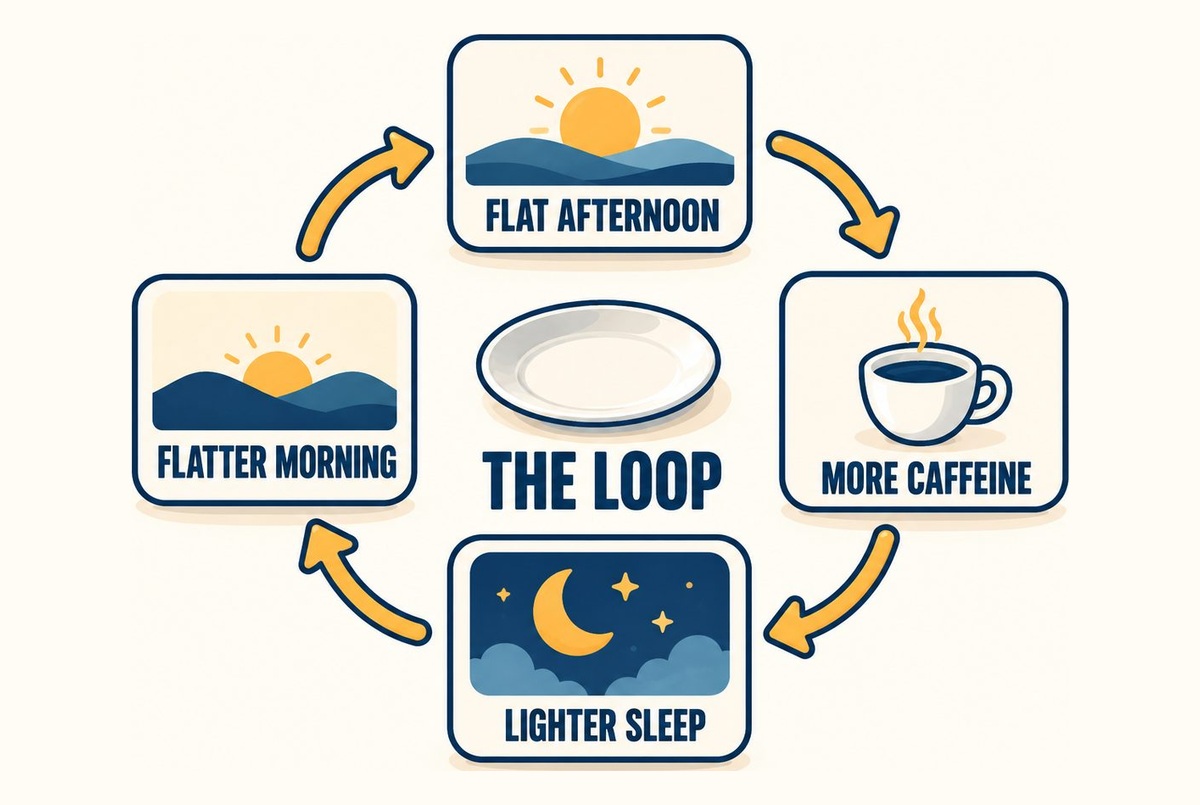
I call this the "Coffee Loop", and it reinforces itself.
Flat afternoon. More caffeine. Lighter sleep. Flatter morning. And underneath it all, the same smaller plate.
My clinical records show a consistent pattern: the patients with the flattest afternoons are the patients eating the least.
One mechanism. One cause. The flat afternoons, the unrefreshing sleep and the cognitive fog are not three separate problems.
They are three presentations of one micronutrient shortfall.
But you do not have to live with it. You can identify what is depleted and restore it deliberately - what I call "closing the gap".
Next I will show you precisely what works: the four nutrients that restored my own afternoons, and did the same for more than 600 of my patients, without a single extra cup of coffee.
What Actually Closes the "Smaller Plate Gap"
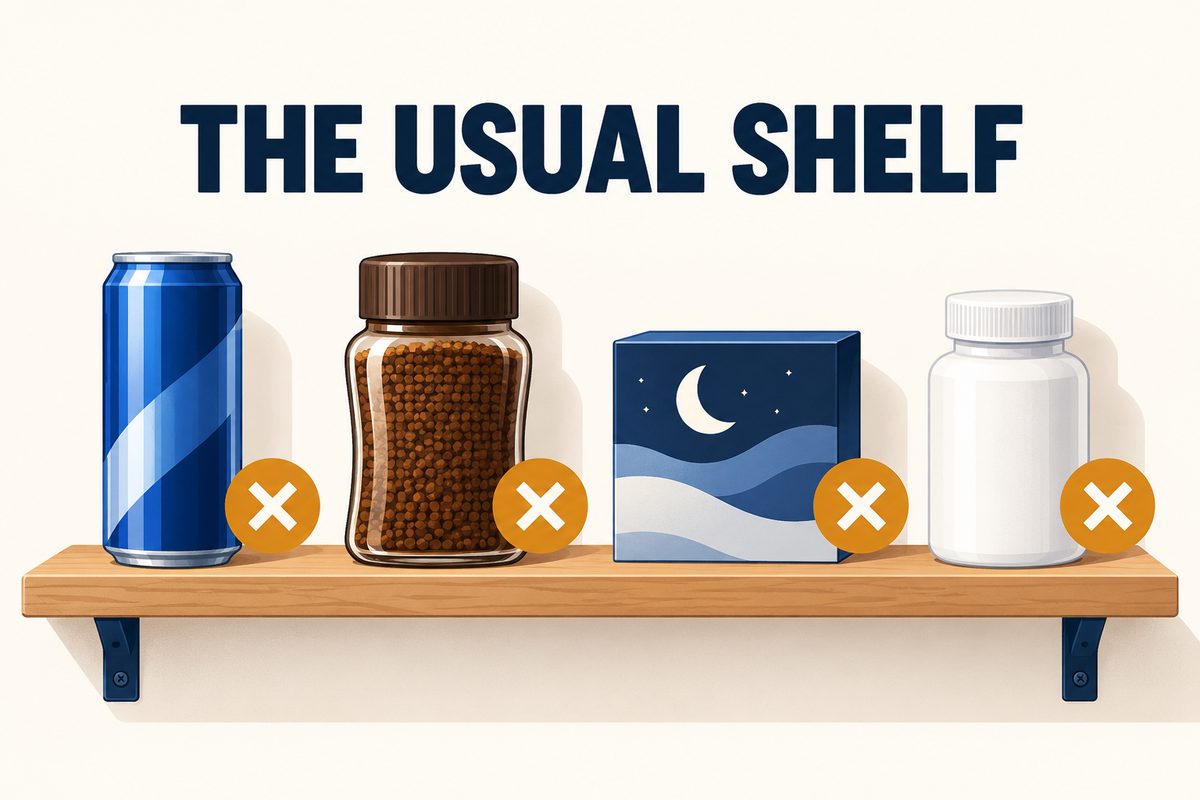
The usual shelf: an energy drink, coffee, a sleep aid and a multivitamin.
I examined the conventional shelf first. Nearly all of it is designed to stimulate you, not to replenish you, and even the standard multivitamin is formulated for someone eating a full plate.
So I partnered with the formulation team to establish what could truly resolve each signal - without adding one more stimulant.
1. For the Flat Afternoons (The Fuel Signal)
We evaluated the whole shelf: energy drinks, something sweet at 3pm, a "B-complex" with no amounts printed. Two deliver a jolt and then a crash, and the third conceals how much you receive.
Then I found it in the NIH fact sheet on vitamin B12: fatigue is a characteristic sign of inadequate cobalamin. Not caffeine and not sugar, but a specific micronutrient in a specified amount.
The result: vitamin B12 supports normal energy metabolism and reduces tiredness and fatigue, with no stimulant and no crash.
Why does it matter most after a year? Because the body's cobalamin reserves are substantial, and they empty slowly. The NIH notes that the symptoms of a B12 deficiency can take several years to appear, which is the exact profile of a problem that arrives late.
BASELINE: B12 LOW.
WEEK 12: B12 IN RANGE.
Reviewing B12 blood work | December 4, 2025
2. For the Sleep That Does Not Refill You (The Reserve Signal)
We reviewed the conventional options: earlier bedtimes, melatonin, a sleep tracker. Not one of them adds a thing to the plate.
Iron and magnesium were different.
The NIH lists weakness, fatigue and difficulty concentrating among the signs of iron-deficiency anemia. And the body requires magnesium for cellular energy production, with fatigue and weakness among the first signs of depletion.
Iron and magnesium arrive almost entirely through food, so a smaller plate reduces both at once.
Iron and magnesium results, side by side | December 15, 2025
In my own patients, the mornings began to change within three weeks.
This combination is particularly relevant for long-term GLP-1 patients.
Restoring them is like recharging a battery that has been operating at one bar for months. The capacity never went away - it simply needed a supply.
3. For the Wired Nights and Foggy Days (The Calm Signal)
This was the most difficult piece. A late coffee sharpens you for an hour and then costs you the night, and most "focus" gummies simply add one more stimulant.
The ingredient that belonged here was ashwagandha, a botanical root extract.
It lifts brain fog and settles the wired nights, without a stimulant.
Now the blueprint was complete. Three complaints, four nutrients - B12, iron, magnesium and ashwagandha - and no caffeine.
Together they could give long-term GLP-1 patients back their afternoons, their mornings and their concentration - with no stimulants, and no change to the prescription.
To deliver all four in one serving, with each vitamin and mineral amount printed, we had to combine them in a single daily capsule routine that sits comfortably on a smaller appetite.
That is why we built GLP-1 Long Run Daily.
What Happened Once We Put It All Together?
I worked with the formulation team, comparing each ingredient against my own clinical checklist, to assemble one daily protocol that addresses all three signals at once. One serving is two capsules with a glass of water.
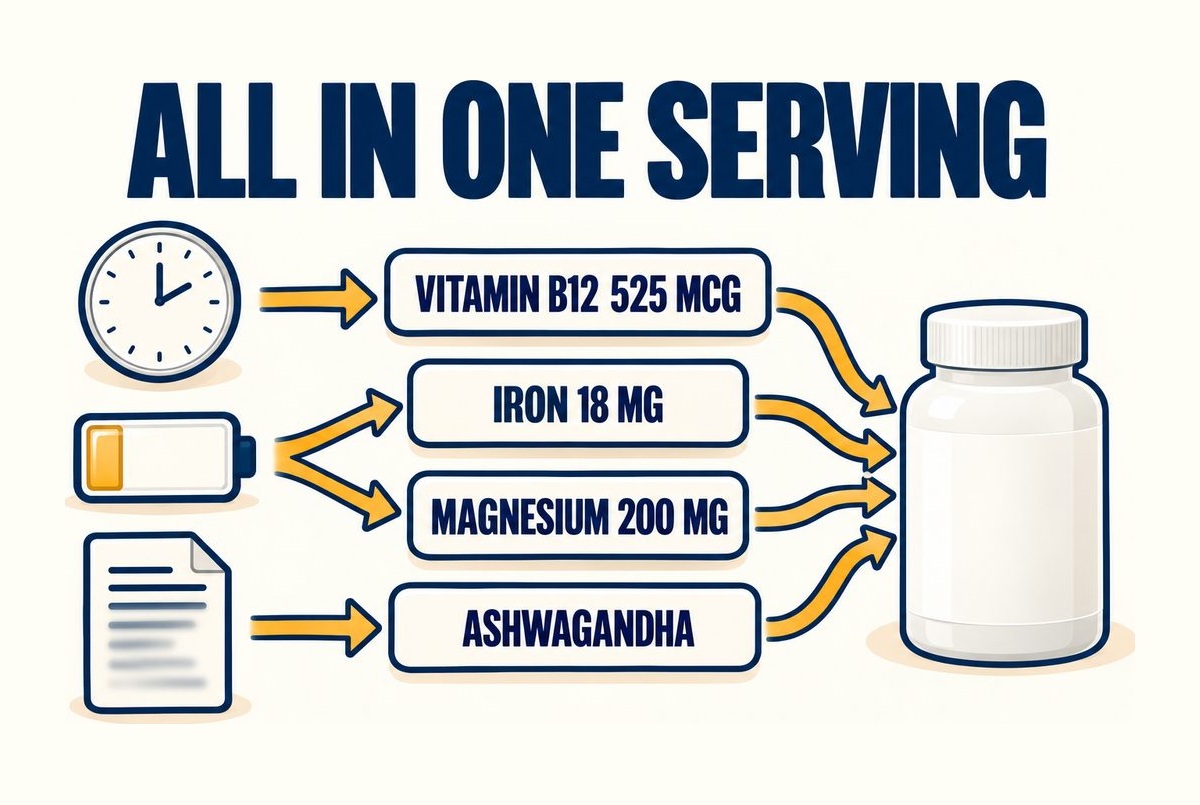
The formulation required fourteen months. With the formulation team, we tested combination after combination until all four nutrients fit into one serving.
Here are the specific changes I recorded once my patients started GLP-1 Long Run Daily:
The Flat Afternoons Lift
The 2pm wall recedes, and that hollow, depleted period after lunch goes with it - usually inside the first 2 weeks.
The "Coffee Loop" Breaks
One cup is sufficient again, and the third coffee becomes unnecessary - by week 3.
The Mornings Come Back
Patients describe waking genuinely rested, without negotiating with the alarm - by week 3.
The Fog Lifts
Words return faster, concentration holds, and you stop rereading the same sentence - by week 4.
The Evenings Return
There is energy left for the walk, the cooking and the phone call you were avoiding - by week 4.
The "Smaller Plate Gap" Closes
And finally, the entire working day stays level, with no collapse at 2pm - by week 6.
It is not magic. It is arithmetic.
The Complete GLP-1 Long Run Daily Formula
The core formula addresses your three signals: B12 for the flat afternoons. Iron and magnesium for the fatigue that sleep does not resolve. Ashwagandha for the wired nights and foggy days. And we included foundational support for a smaller plate:
| Vitamin B12, 525 mcg | Together they support normal energy metabolism and help reduce tiredness and fatigue. |
|---|---|
| Vitamin B6, 26 mg | |
| Iron, 18 mg | |
| Folate, 400 mcg DFE | |
| Magnesium, 200 mg | Supports muscle and nerve function. 48% of the Daily Value. |
| Energy & Vitality Complex, 126 mg | Ashwagandha extract, for the wired nights and the brain fog. |
| Digestive blend, 325 mg | Ginger root extract, peppermint leaf, bromelain and DigeZyme, for comfortable digestion. |
| LactoSpore probiotic, 166 mg | One named strain, 6 billion CFU, for digestive balance. |
| Also on the label | Vitamin D3 50 mcg, zinc 20 mg, biotin 5 mcg, BioPerine 5 mg and a 22 mg Nutrient Replenishment Matrix. |
Two capsules daily, 30 servings a bottle, and no caffeine anywhere on the label.
Every vitamin and mineral has its dose printed beside it, so nothing is hidden behind a name.
The 18 mg of iron is above the 8 mg that men, and women over 50, need, so please ask first.
My Personal Note: Why We Built This
It required fourteen months of work alongside the formulation team: reviewing the nutritional literature, and challenging each ingredient on that label before I recommended it to a single patient.
That work produced the formula on this page. I was its first patient, and I documented each afternoon in a notebook for six weeks.
I take it each morning, two capsules with breakfast, alongside my GLP-1. By the sixth week my 2pm wall had gone, and it has not returned.
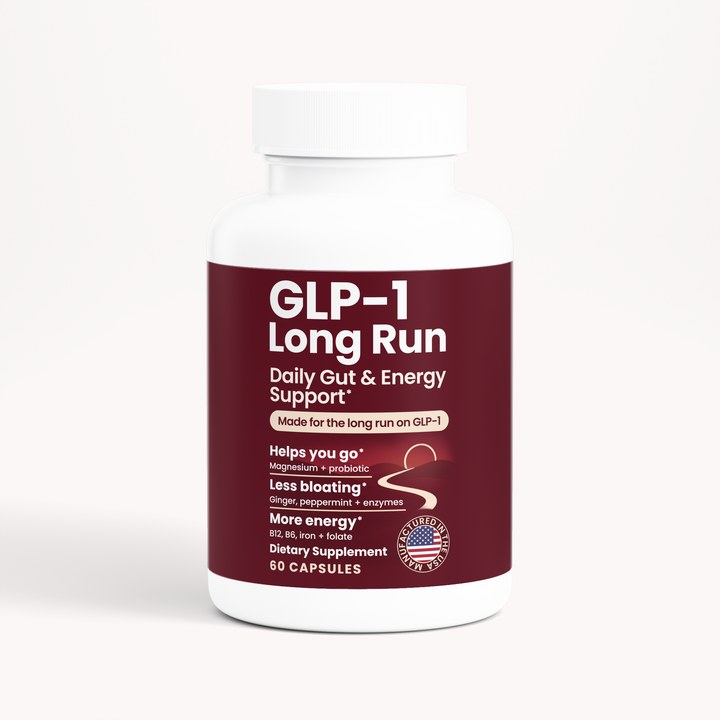
Fourteen months of work, concentrated into one daily serving that restores exactly what a smaller plate removes.
If you are still reading, I already know one thing about you.
You are not here out of idle curiosity - you are here because that checklist was uncomfortably accurate.
The 2pm wall. The eight hours that felt like four. The coffee that stopped working.
We built this formula for people a year or more into a GLP-1. You completed the difficult part and stayed on your medication.
So I arranged a reader price on this page for the people who read this far.
I also stand behind it personally for 60 days, because it works. The gap required a year or more to develop, so give the formula longer than a single afternoon. But if your afternoons are no different, there is no need to send the bottle back. Email the team within 60 days and I will refund every dollar of your first order.
You earned this weight loss, and you should not have to finance it with your energy.
GLP-1 Long Run Daily
Get Your Afternoons Back
- 30-day supply (give it the full 60 days)
- 60-day money-back guarantee
- Monthly refill option available
Regular price: $74.95 Reader price: $39.95 a month
Yes, I Want My Afternoons Back
Monthly plan $39.95 every month until you cancel. One-time purchase $74.95.
Note: GLP-1 Long Run Daily is a dietary supplement and does not replace your GLP-1 prescription. For adults 18 and over, and not for anyone pregnant or nursing.
Mounjaro and Zepbound are registered trademarks of Eli Lilly and Company. GLP-1 Long Run Daily is not made by, affiliated with or endorsed by Eli Lilly or any other maker of GLP-1 medicines.